
















What is the cost to build mobile app in 2026? This is the question when we see millions of apps on the Google Play Store and Apple Store. These apps are getting downloaded more than a billion times, showcasing that the app business is at an outstanding surge.
Almost every industry is investing in mobile app development, considering it a solution to engage customers. There are 5.76 billion smartphone users in the world, so expanding businesses through mobile apps is streamlined and can even boost revenue.
Several factors, including app features, complexity, platform choice, UI/UX design, and much more, influence the mobile app development cost. Apart from this, there is a lot more to learn about app development.
So, here is a guide with the latest stats, proper cost analysis, popular examples, comparisons, factors affecting, and how to choose an app development company. It gives you the right strategy to contribute to the cost to build a mobile app and launching it successfully.
What is The Cost to Develop a Mobile Application 2026?
The average cost to develop a mobile application starts from $8000 to $25,000 on average. Nevertheless, the price can highly vary based on the price of the same. The same is mentioned in the table below:
App Type |
Estimate Cost |
Time |
| MVP App Development | $12,000 – $18,000 |
2-3 months |
| Basic App Development |
$8,000 – $12,000 |
3-6 months |
| Complex App Development | $25,000+ | 9+ months |
App Development Hourly Rates Around the World
Building a mobile app is the best option to expand your business globally. But where to develop mobile apps? This question is raised in every entrepreneur’s mind. It’s right to compare the cost of development around the world.
| Country | Estimated Hourly Rate (USD) |
| United States | $100 – $180 |
| Canada | $90 – $160 |
| United Kingdom | $90 – $150 |
| Germany | $80 – $140 |
| Poland | $40 – $70 |
| Ukraine | $25 – $55 |
| India | $10 – $25 |
| Vietnam | $20 – $40 |
| Philippines | $18 – $35 |
| Brazil | $30 – $60 |
| Australia | $85 – $150 |
| South Africa | $25 – $60 |
Mobile App Development Statistics
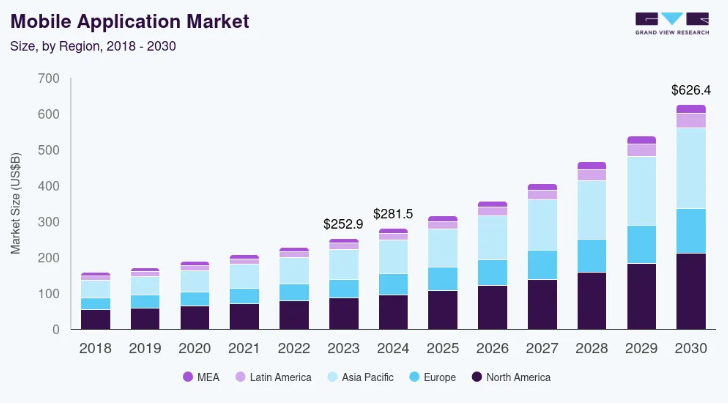
According to Grand View Research, the mobile app development statistics state that:
- The international market size of mobile applications was figured at USD 252.89 billion in 2023 and is now projected to reach USD 626.39 billion by 2030.
- This market is projected to grow at a CAGR of 14.3% from 2024 to 2030.
- In 2023, the Asia Pacific mobile application market dominated the market with 32.0% of the revenue share.
- The US market of mobile applications is expected to grow from 2024 to 2030 with a CAGR of 14.1%.
- In 2023, the Apple Store segment has taken over the market by earning over 62.8% of the revenue share globally.
Understanding App Development Costs Across App Types
Are you ready to develop a mobile app? But have you decided which app type you want to develop? Still don’t know what app types are? There are various app types, such as Android apps, iOS apps, web apps, hybrid apps, cross-platform apps, Progressive Web Apps, Desktop Apps, Native apps, and tablet-specific apps.
1. Android Apps
Simply Android apps are only running on Android devices and use Kotlin or Java. Development costs vary due to device fragmentation, as apps must support many screen sizes and hardware types. Despite higher testing efforts, Android is ideal for reaching a global audience. It’s cost-effective for businesses targeting diverse markets and budget-conscious users.
2. iOS Apps
iOS apps are basically used for Apple devices such as iPhones and iPads, and use Swift or Objective-C. These types of apps cost more due to Apple’s strict guidelines, and they must offer higher performance and a seamless user interface. These apps are ideal for premium audiences because Apple device users are fewer and their development ensures smooth functionality.
3. Web Apps
Web apps run directly in browsers without requiring installation, making them cost-effective and easy to maintain. They are platform-independent and built using HTML, CSS, and JavaScript frameworks. App Development costs remain moderate because updates roll out instantly to all users. Web apps are ideal for businesses seeking broad accessibility, quick deployment, and reduced maintenance across multiple devices.
4. Hybrid Apps
The hybrid applications combine the technology of web-based and native containers, and they enable access to the apps on both devices, such as iOS and Android devices. For hybrid app development, developers use only a single codebase, which can reduce the App development cost and time. These apps can not handle full-featured projects; it is ideal for MVPs and mid-complex projects.
5. Progressive Web Apps
PWAs combine web and app features, offering offline access, push notifications, and app-like interfaces directly in a browser. They’re cheaper than native apps because they use one codebase and require no app store deployment. PWAs deliver fast performance, easy updates, and broad compatibility, making them perfect for businesses wanting a low-cost alternative to traditional mobile apps.

6. Desktop Apps
The desktop applications are mainly for the operating systems such as macOS, Windows, Linux, Unix, and other operating systems. Building desktop applications requires platform-specific development, this can increase overall cost. These apps are ideal for productivity, business software, and require high-performance or complex features. Desktop apps can run as offline and provide robust performance.
7. Native Apps
The Native applications are mainly built for one specific platform, either Android or iOS. They offer the best performance, security, and user experience, but app development cost more due to needing separate codebases. Native development is ideal for apps requiring advanced hardware features, real-time processing, or high-quality graphics. It’s the premium choice for scalability and long-term reliability.
8. Wearable Apps
Reading the name of a wearable, you already get a hint that these apps are designed for wearable devices such as smartwatches and fitness trackers. It is lightweight apps and small user-interfaces, optimizing performance, and efficient battery usage. The total cost depends on the various integrations, such as heart rate monitoring sensors, mobile app companions, and health data.
| App Type | Estimated Development Cost Range | Notes |
| Android Apps | $8,000 – $15,000+ | Costs vary due to device fragmentation and extensive testing. |
| iOS Apps | $12,000 – $18,000+ | Slightly higher due to strict Apple standards and premium optimization. |
| Web Apps | $10,000 – $14,000+ | More cost-effective; dependent on backend complexity. |
| Hybrid Apps | $8,000 – $14,000+ | One codebase for iOS & Android reduces development time and cost. |
| Progressive Web Apps (PWAs) | $9,000 – $20,000+ | Affordable alternative to native apps with app-like features. |
| Desktop Apps | $12,000 – $20,000+ | Higher cost due to platform-specific builds and advanced features. |
| Native Apps | $15,000 – $25,000+ (per platform) | Top performance but requires separate builds for Android & iOS. |
| Wearable Apps | $10,000 – $16,000+ | Cost depends on sensor integrations, health data, and companion apps. |
Read More: Android App Development Cost in USA
Most Popular Examples of App Types and Estimated Costs
It is good to know the cost of popular apps, because entrepreneurs get an idea of how much they pay for a specific app type. And they can also make similar apps to them. So, let’s explore the existing app types and their approximate cost:
1. Apps Like Amazon(Leading E-commerce App)
No one who doesn’t know about the Amazon, it is a globally ranked e-commerce application, and most entrepreneurs want to develop an app like Amazon. Most people don’t know that Amazon started as a bookstore founded by Jeff Bezos in 1994. And now it is one of the most valuable companies that offer everything like a marketplace, digital streaming services, and cloud services.
| Features | Estimated Development Time |
| Product Catalog & Categories | 120 – 180 hours |
| Product Search & Filters | 90 – 140 hours |
| Product Details Page | 60 – 90 hours |
| Shopping Cart | 70 – 110 hours |
| Payment Gateway Integration | 90 – 140 hours |
| Order Tracking | 80 – 120 hours |
| Wishlist & Favorites | 50 – 80 hours |
2. Apps Like Uber(Popular On-Demand Service App)
When a conversation comes to taxi booking services, the first name that comes to the user’s mind is Uber. To develop an app like Uber, needs to integrate advanced features such as real-time ride tracking, online payment options, fare calculation, freight transport, and more. Have you ever thought about when Uber launched their ride-hailing services? You can’t imagine, it started from 2011 when no one had any clue of these types of services.
| Features | Estimated Development Time |
| Real-Time Ride Booking | 120 – 180 hours |
| Geo-Location & Maps Integration | 110 – 160 hours |
| Real-Time Ride Tracking | 130 – 180 hours |
| Fare Calculation & Estimation | 60 – 90 hours |
| In-App Payments | 80 – 130 hours |
| Driver Management (Driver App Module) | 150 – 220 hours |
| Ratings & Reviews | 50 – 90 hours |
3. Apps Like Instagram(Best Social Media App)
In the last few years, Instagram has been one of the fastest-growing social media platforms; before that, it was known as an instant camera app. This platform integrates some advanced features to reach a global audience, such as short-form video sharing, news feed, filters with hashtags, and more. Of course, entrepreneurs who want to build a social media app can make an app like Instagram.
| Features | Estimated Development Time |
| User Feed | 110 – 180 hours |
| Communication Channels (Chat) | 80 – 110 hours |
| Likes & Comments | 60 – 80 hours |
| Stories | 90 – 150 hours |
| Post Photos & Videos | 60 – 90 hours |
| Followers & Followings | 80 – 150 hours |
| Tags & Mentions | 90 – 140 hours |
4. Apps Like Spotify(Popular Audio Streaming App)
Are you ready to build an app like Spotify? It is one of the leading audio streaming platform that include 100 million songs and 7 million podcast titles. This digital platform involves premium features such as offline listening, high audio quality, AI-powered features, personalized mixes, audiobooks, and settings. But it can go to a higher cost as compared to normal audio streaming applications.
| Features | Estimated Development Time |
| Music Library & Categories | 120 – 180 hours |
| Search (Songs, Artists, Albums) | 80 – 130 hours |
| Audio Streaming Player | 140 – 200 hours |
| Playlists (Create/Add/Delete) | 70 – 110 hours |
| Offline Download Feature | 120 – 170 hours |
| Recommendation Engine | 140 – 220 hours |
| Subscription & Payments | 80 – 120 hours |
5. Apps Like Netflix(Leading Video Streaming App)
When talking about video streaming services, the first name that comes as Netflix. It is an internationally recognized subscription-based video streaming platform that offers various content such as movies, web series, TV shows, games, and documentaries. As per the recent survey, Netflix is the 18th most-visited website in the world. It is one of the biggest reasons that entrepreneurs want to create an app like Netflix.
| Features | Estimated Development Time |
| Video Library & Categories | 140 – 200 hours |
| Adaptive Video Player | 160 – 230 hours |
| Search (Movies, Shows) | 80 – 120 hours |
| Watchlist | 50 – 80 hours |
| Continue Watching | 60 – 90 hours |
| Download for Offline Viewing | 140 – 190 hours |
| Recommendation Engine | 150 – 240 hours |
Let’s explore the quick overview of each example of the app type:
| Examples of App Type | Estimated Cost |
| App Like Amazon | $20,000 – $25,000 |
| App Like Uber | $17,000 – $23,000 |
| App Like Instagram | $21,000 – $27,000 |
| App Like Spotify | $15,000 – $20,000 |
| App Like Netflix | $18,000 – $25,000 |
Different Types of Mobile Application Developers and Their Cost
It is no rocket science that when you want to develop a mobile application regardless of platform or its type the first thing you need to do is hire a mobile app developer. Now, it is simple enough, but there are different types of developers. And depending on which one of these you hire, the Cost to develop a mobile app can also vary greatly.
So, let’s see how a freelancer can affect the cost:
1. Hire a Local Agency
If you are living in a big city, there should be a lot of application development companies around you. All you need to do is choose the right Mobile app-building company for you. There is a criterion for doing so, and we shall be discussing the same later. As far as the price for the same is concerned, it can range between $ 8,000 and $15,000.
2. Freelancer
Freelancers are the first thing that comes to our minds when we talk about hiring a developer for creating a mobile application. You see, there are a lot of freelancers across the world. And one of the best things you get with this option is that your freelancer can be anywhere and still provide their services.
The cost of hiring freelancers can greatly differ based on the (but not limited to) following factors:
- Experience
- Expertise
- Project
- Location
Nevertheless, the Cost to hire an Android developer would be anywhere between 10$ per hour to 20$ per hour.
3. Outsourcing Company
Outsourcing work is the most popular mode of hiring a developer among the bunch. Outsourcing as we know it means transferring the project to an Android app development company and they will do it for you. This is done for a said amount of money of course.
Now, there are many benefits you get from hiring an outsourcing company. To name a few, they have an entire dedicated team of developers, they have a lot of relevant experience, and they are preferable options when it comes to after-development services.
Again, the price of the development will depend on many different factors. But if we speak of an average, it would be between 15000 USD to 25000 USD.
4. In-House Team
The second and the least popular option for hiring developers is employing one. Now you might be wondering why it is the least popular of the bunch. And how you may answer your query of finding app developers near me? The reason behind this suggestion is that assembling an in-house team is not that difficult.
Firstly you have to hire a recruiter who will hire developers for you. Now, developers are not cheap, and you will have to pay a monthly salary. But apart from these drawbacks, there are some benefits like you can have face-to-face interaction with them. In addition to this, they will work wholly dedicated to your project which results in better productivity.
App Development Cost For Each Phase
Now, all of the cost to develop a mobile app is concentrated on one point and that is developing the app itself. Confused? Well, let us explain. Development of application in the technical sense is what costs the most, and there are various steps in this.
To better understand the cost of mobile application development, we shall be looking at what these different phases of the development cost.
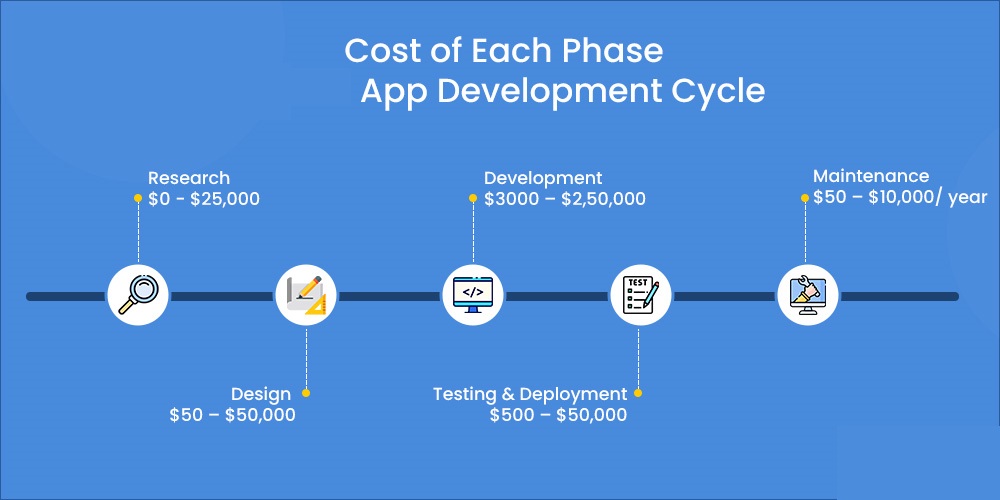
Usually, the mobile application process can be divided into six different steps or phases, as some might call them.
These are, as mentioned below:
- Market Analysis and Research
- UI/UX design
- App development
- Project management
- App testing and deployment
- Ongoing support and maintenance
It doesn’t matter how big your application is or how complex it is, these are the six-step process it has to go through. So, let’s see how much each of these steps costs you individually.
1. Market Analysis and Research
The first step or phase of mobile application development is conducting market research and analysis. After all, you need to make sure that your idea is unique and also relatable to the real market. This is the reason why this step is so important.
Here you will be looking at the application of your idea in the market and the viability of the same with the audience base. You don’t want to introduce a mobile application that doesn’t have a target audience.
In addition, you will also need to conduct a competitor analysis. Because you want to know who you are competing against to win the race.
If you hire a good hybrid app development company, they would conduct the research and let you know where the areas which have room for improvement are. Plus, the reviews and feedback on the applications of competitors can also be analyzed to see where they are lacking. Later on, you can strengthen these points in your mobile application.
Coming to the cost of the same, the market audit phase usually costs between $1,200 to $5,000. This is for the time between 2-4 weeks. As such, if you hire experienced developers they would use around 10% of the entire budget during this phase.
2. UI/UX Design
Whether you are wondering about the mobile app development budget, one thing you must know is that the first impression of the app is the most important one. This is the reason why UI/UX plays such an important part. If this is an important part of the application, it must also cost you a lot of money, right? Exactly.
UI/UX designing takes a lot of development budget since it takes a lot of time and effort from the developers’ side. Now, choosing UI/UX that is more complex is going to cost you more money, on the other hand, if it’s really simple, it will be comparatively cheaper.
Nevertheless, this phase of the development would cost you anywhere between $2,500 to $6,000.
3. App Development
This is the phase where all of the codings are done. Therefore, codings the programming and coding costs are associated with this part. Just so that you know, this is also the step that takes the largest chunk of the cost to develop a mobile app.
When we talk about app development cost, this is something you neither comprise with nor neglect. Speaking of cost, the application app architecture and functionality development costs range from $20,000 to $25,000.
The range in this one is the largest of the bunch because it again depends on the complexity of the application.
4. Project Management
Project management is yet another important part of the whole development cost. After all, it is none other than the project manager who looks after and controls the whole development process from business analysis to app maintenance.
Whether you talk about an app development cost, the project manager makes sure the quality is followed throughout the same. This is also the reason why you have to pay the manager 10 to 15% of the total mobile application development budget. This translates to around $1,200 to $5,000.
5. Testing and Deployment
Before the mobile application is deployed into the real market, it has to be tested. Testing is an important part of application development. The reason is that without this step the application will be filled with errors and lack in quality.
The developers themselves incorporate various yet precise testing systems. This is done when the application is deployed in a live environment. And when all of it is done, the application is developed in the real market. As far as cost is concerned, the app testing and deployment phase costs less than $5,000.
You can reach out anytime; we are available 24/7. Our team provides a quick response.

6. App Maintenance
Contrary to popular belief launching an application in the market won’t put a full stop to the expenses. After you have deployed the application on either the app store or play store, there are still things that will add to the cost to develop a mobile app.
We are talking about the maintenance of the mobile application. As such mobile application maintenance includes the following things:
- Fixing bugs
- Updating your app to the latest OS versions
- Upgrading the app to make it compatible with new technologies
- Code optimization
- Improving app stability
- Scale up the server infrastructure as the number of users grows
Now, maintenance is a crucial step, but there is no fixed price tag on this. This is because it can highly vary based on the application and niche. Nevertheless, it usually takes up to 10-20% of the development cost.
Factors Affecting The Mobile App Development Cost 2026-2027
Various factors can affect the Cost of Develop A Mobile App. In this section of the blog, we shall be discussing the very same factors. With this being said, let’s start with one of the most important factors which is “complexity”.
1. Complexity
If you hire an on-demand app development company they will let you know that the complexity of the mobile application is the most affected factor. And several different things can add up to the complexity. For instance that more advanced features, the developers will take more time as well as effort to do the same.
In addition to this, we already know that the more complex an application is, the more time it is going to need to get developed. And the more time it takes to develop the application, the more expensive it is for the client. So, this is one of the factors you need to look out for.
| Complexity Level | Description | Estimated Cost Range |
| Basic | Simple app with essential features and minimal UI | $8,000 – $12,000 |
| Medium | Standard app with user login, dashboards, and APIs | $12,000 – $18,000 |
| Advanced | Complex app with third-party integrations, push notifications, etc. | $18,000 – $25,000 |
| High-End | AI, AR/VR, advanced security, multi-module system | $25,000 – $30,000 |
2. Platform
Everyone knows that there are two big boys in the world of mobiles regarding platforms. These are the iOS from Apple and Android from Google. Whether you decide to hire an iPhone app developer or an Android one, it is going to affect the cost greatly.
You see, there is a lot of difference between Android app development and iOS application development. One of the points within this factor is that Android application development suffers from fragmentation. This is due to the largely unregulated Android versions in the market.
on the other hand, iOS is only used by Apple and is highly regulated by the same. This is the reason why the development time is faster as well as cheaper. This is how this factor affects the cost of development and you can finalize whether you want to hire an android app developer or an iOS one.
| Platform Choice | Description | Estimated Cost Range |
| Android Only | Single platform with a wide user base, higher testing effort | $8,000 – $15,000 |
| iOS Only | Controlled ecosystem, faster development | $10,000 – $16,000 |
| Cross-Platform (Flutter/React Native) | One codebase for both iOS & Android | $15,000 – $22,000 |
| Native for Both (Android + iOS) | Separate builds, higher quality & performance | $22,000 – $30,000 |
3. Location
Location is where the developer or the mobile application development company is based placed a big role in the final cost of the application development. North America, Australia, the UK, South America, India, Ukraine, and Indonesia are some of the top countries when it comes to mobile application development.
Now, the price of the development cost depends on which of these places the developer is based. as such, the countries which are in Asia usually charge between $10 to $25 per hour. On the other hand, other countries from Europe and Australia are higher ranging between $80 to $110.
Now, this gets overhead and most expensive when you are talking about North America with a price range between $250 to $350+ per hour. However, this doesn’t mean that the countries with cheaper prices do the bad work and one with more expensive ones do it better. Various things cause this difference, but we won’t be getting into this.
| Developer Location | Hourly Rate | Estimated Cost Range |
| Asia (India, Indonesia, etc.) | $10 – $25/hr | $8,000 – $15,000 |
| Eastern Europe (Ukraine, Poland, etc.) | $30 – $50/hr | $12,000 – $20,000 |
| Western Europe & Australia | $80 – $110/hr | $18,000 – $25,000 |
| North America (USA, Canada) | $150 – $250/hr | $25,000 – $30,000 |
4. Features
Features are one of the most important components of any application. It is often said that good features can make an app and bad ones can break it. This is true as users usually judge the application by how good its features are.
While you can hire a custom iOS app development company, features will still affect the price of the development. The more advanced features you want the more expensive they are going to be.
| Feature Set | Description | Estimated Cost Range |
| Basic Features | Login, profile, simple UI, basic database | $8,000 – $12,000 |
| Standard Features | Push notifications, payment gateway, APIs | $12,000 – $18,000 |
| Advanced Features | Real-time chat, maps, media uploads, analytics | $18,000 – $25,000 |
| Premium Features | AI integration, AR/VR, IoT connectivity, multi-device sync | $25,000 – $30,000 |
5. Third-Party Integrations
In a mobile app, integrating third-party tools and applications is necessary because it can increase the overall accessibility and flexibility. It includes various common integrations such as secure payment gateways, social media logins, CRM, ERP, analytics and reporting, communication tools, and more. But some of the integrations have higher licensing fees and developers take more time to implement, this directly impacts the overall app development cost.
| Impact Area | Description | Estimated Cost Impact |
| Payment Gateways | Adding Stripe, PayPal, etc. | +$800 – $3,000 |
| Maps & Location Services | Google Maps, geolocation APIs | +$600 – $2,500 |
| Social Login & APIs | Google, Apple, Facebook integrations | +$400 – $1,800 |
6. Design UI/UX
Moving to another cost-affecting factor, designing a user interface of a mobile app can be expensive due to high-quality designs, and some of them are paid for. Designing involves a wide variety of UI elements such as templates, in-built plugins, layouts, fonts, styles, textures, colors, themes, and more. So, these design elements can influence the cost to develop a mobile app and also increase the development time.
| Impact Area | Description | Estimated Cost Impact |
| Basic UI Layout | Simple screens, standard components | +$700 – $2,000 |
| Custom UI Elements | Advanced graphics, animations | +$1,500 – $5,000 |
| User Experience Flows | Wireframes, prototyping, usability planning | +$1,000 – $4,000 |
7. Maintenance and Support Services
Let’s look at the last factor. Entrepreneurs want their mobile app to perform well and every operation to run smoothly. For that need to conduct the post-launch maintenance services such as fixing bugs or errors, upgrading to the latest OS version, regular updates, performance optimization, backups, and more. These maintenance services can simply increase the cost of maintenance, and this can directly raise the final cost to build a mobile app.
| Impact Area | Description | Estimated Cost Impact |
| Bug Fixes & Updates | Ensuring stability after launch | +$500 – $2,500 per year |
| Server & Hosting Costs | Backend upkeep & storage | +$300 – $1,200 per year |
| Feature Enhancements | Adding improvements over time | +$1,000 – $4,000 |
How To Reduce The Mobile App Development Cost 2026-2027?
While talking about the mobile app development rates, make sure your app is optimized to stay within budget by cutting costs. Cutting costs by opting for app development with MVP, on a single platform, using pre-built solutions, and so on, can lead you to get maximum ROI. Let’s discuss the measures to reduce the development cost of a mobile app.
1. Begin Your App with MVP
Creating your app with an MVP (Minimum Viable Product) or a basic version that only has essential features can lower the app development cost. With this concept, you only focus on investing in primary features before investing in advanced ones, and it saves time and cost.
| Approach | Estimated Cost | Savings Compared to Full App |
| MVP with basic features | $8,000 – $11,000 | Save $2,000 – $3,000 |
| MVP with moderate features | $11,000 – $14,000 | Save $2,500 – $3,500 |
| MVP with scalable core system | $14,000 – $17,000 | Save $3,000 – $4,000 |
2. Pick One Platform Initially
Launching the app on the web, Android, and iOS can increase the cost to create a mobile app. So it is better to start with a single platform with a target audience. Once the app catches popularity, you can expand it by thinking of a more cost-saving development strategy.
| Platform Choice | Estimated Cost | Savings Compared to Dual Platform |
| Android only | $9,000 – $12,000 | Save $2,000 – $3,000 |
| iOS only | $10,000 – $13,000 | Save $2,500 – $3,500 |
| Cross-platform (Flutter/React Native) | $13,000 – $16,000 | Save $3,000 – $4,000 |
3. Utilize Pre-built Framework
Making a fresh start from scratch can increase development time and cost. It is better to use pre-built frameworks like Flutter or React Native and ready-made APIs. This helps reduce the overall cost to make a mobile app without negotiating with quality.
| Method | Estimated Cost | Savings Compared to Custom Development |
| Ready-made APIs | $10,000 – $13,000 | Save $2,000 – $3,000 |
| Pre-built UI components | $12,000 – $15,000 | Save $2,500 – $3,500 |
| Full cross-platform framework | $14,000 – $17,000 | Save $3,000 – $4,000 |
4. Hire Inexpensive Developers
The hourly price of a developer varies globally. So, hire mobile app developers cost gets lower in regions including Asia and Eastern Europe. You will get high-quality work and efficient developers from these regions that work without sacrificing performance.
| Location | Estimated Cost | Savings Compared to North America |
| Asia (India, Indonesia, etc.) | $8,000 – $11,000 | Save $2,500 – $3,500 |
| Eastern Europe (Ukraine, Poland, etc.) | $11,000 – $14,000 | Save $2,000 – $3,000 |
| Latin America | $13,000 – $16,000 | Save $3,000 – $4,000 |
5. Effective Planning
We have heard that planning makes everything better and easier to execute. Similarly, having clarity in features, timelines, and budgets before anything reduces the cost to develop a mobile app. Planned execution of every step will avoid extra expenses.
| Planning Level | Estimated Cost | Savings by Avoiding Rework |
| Clear wireframes & documentation | $9,000 – $12,000 | Save $2,000 – $3,000 |
| Defined feature list & timelines | $11,000 – $14,000 | Save $2,500 – $3,500 |
| Dedicated project management | $13,000 – $16,000 | Save $3,000 – $4,000 |
5 Hidden App Development Costs
Yes, there are various hidden costs that exist during the mobile app development process. Businesses must be aware of these hidden costs to avoid them and maintain their total project budget. So, here we provide several hidden cost factors:
1. App Store Submission Fees
Publishing apps to the Apple App Store or Google Play Store requires registration and annual fees. Apple charges $99/year, while Google charges a $25 one-time fee. Additional costs may arise for updates, compliance checks, or featured placement, which are frequently overlooked during initial project estimates, adding unexpected expenses post-development.
2. Security Measures
Implementing strong security protocols, encryption, and secure data storage adds development complexity. Protecting user data against breaches is mandatory, especially for apps handling payments, health, or personal information. While sometimes considered optional, failing to budget for security can result in costly post-launch fixes or regulatory penalties.
3. Analytics & Tracking Tools
Integrating analytics, A/B testing, and user behavior tracking involves setup, subscription fees, and ongoing management. While vital for app optimization and marketing decisions, the costs of these tools are often overlooked. Ignoring analytics can reduce insights for growth, while adding them later increases development complexity and expenses.
4. Marketing and User Acquisition
Even the best app needs promotion. Marketing, app store optimization, and paid campaigns are often forgotten during budgeting. Without allocating funds, app downloads and revenue may be lower than expected. Effective marketing strategies are essential for ROI, making this a hidden but indispensable cost alongside development.
5. Testing and Quality Assurance
Extensive QA is essential to ensure a smooth, bug-free app. App Development Costs include device testing, automated scripts, and user testing across multiple platforms. Skipping thorough testing may reduce initial costs but leads to higher maintenance expenses and user dissatisfaction after launch, making it a hidden but crucial component of total development cost.
Things To Look Out For When Choosing an App Development Company
When you are looking for a mobile app development company, there are some things you need to keep in mind. With this you can make sure the people you are hiring are the right match to do your job the way you want it, with this being said, we shall be discussing the same below:
1. The Project Requirement
Before you go consulting top app development companies, the first thing you need to do is decide on your project requirement. If this is clear it would be easier for you to talk to developers, and for them to understand your needs. Here, you also need to decide upon the fund allocation as well as the timeline along with the developed platform.
If you can write down the technologies you want to be put into your application that would be even better. In short, make a list of everything including what you want, and how you want it. This is the first step you need to before looking for a developer.
2. Full-Service Companies
Now, there is a lot of different kind of mobile application development companies. Some have a big name along with an impressive portfolio. You want to make sure that you hire one of those companies that have qualified development specialists with the right experience. You must also determine that the company you hire must choose the best framework for app development.
With this you will make sure, your application is in the right hands, if not the best hands. You should also make sure whether or not the development company has all the required resources needed in different phases of development.
3. Interview The developers
If you want to hire an on-demand app development company, the first step will be to talk to their sales representative. While this might be good enough for you, you should also consider interviewing the developers directly.
Take your time to question the developers’ team thoroughly as they will be handling the application through the development process. Here, you can also ask them about their previous experience and their views on the current ones. Conversing with developers will help you gain insight.
4. Portfolio
When you are in a meeting with a mobile app Development Company’s representative, ask them about their portfolio. Companies who are proud of what they are doing will show their portfolio even without you asking.
This will provide you with some knowledge about the company’s work and the company itself in general. So, this is an important thing to do when you are in talks with a mobile app developer.
5. Privacy and Data Security Policy
The privacy and data security of the mobile app is the important thing. After all, nobody wants their business-related data to be floating around on the internet.
Thus, you want your developers to sign confidentiality as well as a non-disclosure agreement. This is an important step in protecting your sensitive information. If the developers aren’t too keen on agreeing with this step, it is recommended to not move further with that company.
How Do Mobile Apps Make Money?
Why entrepreneurs build mobile apps? It’s simple, just make money from their own platforms and increase the revenue streams. But some businesses don’t know how to generate money and what the legal ways of make money. So, here we provide the best and legal ways to generate profits:
1. Subscription Plans
Users pay recurring fees, weekly, monthly, or yearly, for premium content, features, or services. Popular with streaming, fitness, and productivity apps, subscriptions create predictable revenue. Offering free trials or tiered pricing encourages adoption. The model emphasizes long-term retention, ensuring steady income as long as users perceive ongoing value.
2. Paid Apps
Users pay upfront to download the app. This approach works best for niche, high-value, or professional apps where users are willing to pay immediately. Revenue depends on volume of downloads. While it limits reach compared to free apps, upfront payments generate instant cash and reduce reliance on ads or other monetization strategies.
3. In-App Advertising
Apps display ads such as banners, videos, or interstitials from ad networks. Developers earn revenue based on impressions, clicks, or user engagement. While free for users, ad-based apps require a large audience for significant income. Proper placement and targeting enhance earnings without disrupting user experience.
4. Sponsorships & Partnerships
Apps collaborate with brands or organizations for sponsored content, promotions, or exclusive offers. Revenue comes from sponsorship deals rather than direct user payments. This method works well for apps with a specific niche, strong user base, or high engagement. Partnerships can also enhance brand credibility and user trust.
5. Selling Physical Products
Apps can sell merchandise, hardware, or other tangible goods directly to users. E-commerce, fitness, or brand-related apps often use this model. Revenue comes from direct sales, complementing digital services. Integrating secure payment gateways and a smooth user experience is crucial for maximizing conversions and repeat purchases.
How is App Development Cost Estimated- The Formula
Is there any method to calculate the mobile app development pricing? Well, there is a formula to calculate the cost of application development. Here, we take into consideration the main processes of the application development phases.
The same formula is, as mentioned below:
UI/UX Design Hours + App development hours (depends on platform) + backend Hours × Hourly rate of Developers = Total Cost of Development
Conclusion
In this blog, we looked at each and everything related to the mobile app development cost 2026-2027. Starting from the different methods of hiring a developer to the various factors that can affect the cost to develop a mobile application.
All of these points were important when you speak about the price of the development. But something we learned along the way is that one cannot pinpoint the price without knowing the specification of the project.
That is why we recommend you to consult a professional mobile application developer as they can help you better understand the cost and also reduce it to an extent.
Frequently Asked Questions
Find answers to the most common questions related to this article.
The cost to develop a mobile app typically ranges from $8,000 to $25,000, depending on features, platform, design complexity, development team location, and technology stack used for building the application.
Depending on the nature of the application as well as the features and other aspects, the final cost of building an app can vary. Apart from this, the average cost is between 8000 USD to 25,000 USD based on the complexity of the app.
Again, depending on the complexity of the app and the type of app you want, it can take anywhere between 2 months and 10 months + for app development. However, the best way to build mobile apps is to use a combination of user-centric design, agile development, and robust testing.
There are multiple ways through which you can hire an app developer. These are, as mentioned below:
Local Company
Outsourcing Company
Freelancer
In-house team
The post-release maintenance of the application takes up to 10% of the total budget meaning somewhere between 1000$ to 2000$.
The cost to hire mobile app developers ranges from $15 to $25 per hour, depending on location, expertise, and project complexity. Rates are typically lower in Eastern Europe and Asia.
The top 200 apps on the App Store earn around $82,500 per day, while in the top 800 apps, the average income falls to around $3,500.